
Imagine finding the perfect necklace and flipping it over to see a tiny stamp labelled 750 or even 925. What on earth does that even mean?
If you’re assuming these are random numbers that mean nothing, you might want to think again. These numbers tell you exactly what you’re buying, and whether you’re really getting value for your investment.
Think of these hallmarks as the jewellery industry’s secret code. We’ve taken it upon ourselves to walk you through what they mean.
Let’s dive in, shall we?
What Are Hallmarks and Why Do They Matter?
Hallmarks are official stamps that indicate a jewellery item’s metal purity. It’s the guarantee that the piece’s metal composition truly meets the industry standards.
That’s exactly why hallmarks exist in the first place, because precious metals are valuable. Without these markings, which, by the way, are standardised across the globe, anyone could claim their jewellery piece was solid gold even if it wasn’t. Not a good situation to be stuck in, is it?
Hallmark stamps protect consumers and tell you:
Take luxury houses such as Van Cleef Arpels or Cartier, for example. Every time you buy a piece from them, you’ll find a 750 stamped neatly inside. This is your guarantee that it’s made in 18-karat gold. This stamp represents centuries of standardisation and consumer protection.
Be warned, though, fair reader: these hallmarks most definitely do not guarantee the authenticity of the entire piece. It’s a dangerous world out there, and hallmark stamps can be forged.
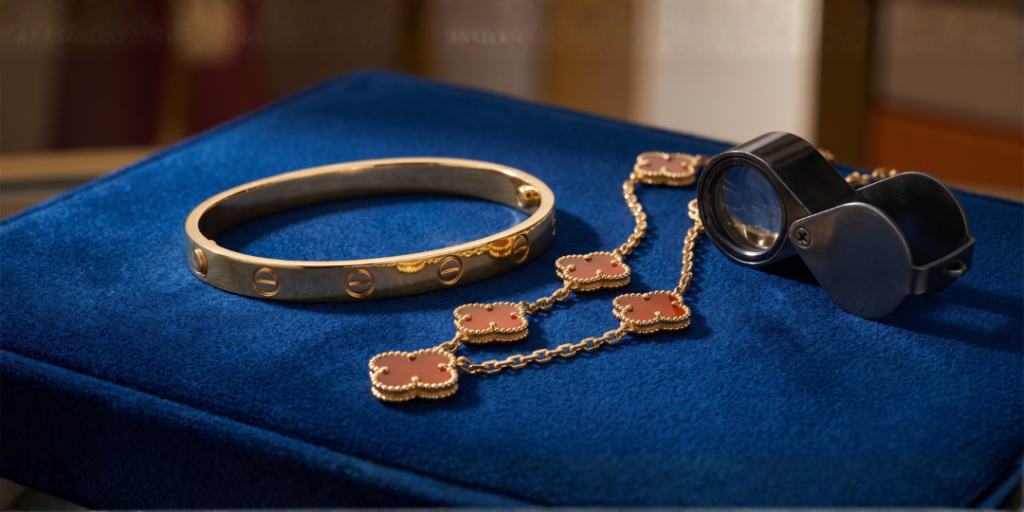
Simply put, 750 means 18-karat gold that contains 75% pure gold.
But what does that mean?
Pure gold is 24 karats, meaning it’s r 100% gold and contains no other metals. However, pure gold is soft, prone to bending, scratching, and wearing out quickly, which is why jewellery pieces made from 24-karat gold wouldn’t withstand the everyday wear and tear that comes with life.
This is why jewellers mix gold with other metals, such as copper, silver, nickel or palladium. This creates alloys that are still gold but a lot more durable.
So, 750 gold is made up of 75% pure gold and 25% other metals. These metals, called alloys, provide gold with durability without sacrificing its value.
You’ll frequently find the jewellery stamp 750 on:
You’ll typically find the stamp inside the ring band, on the necklace clasp, or on the bracelet’s interior surface. It’s small, requiring careful inspection.
Contrary to popular belief, jewellery stamped 750 doesn’t always look the same colour. That’s because the alloy metals create different finishes:
So, yes, all versions are 750 gold, they’re just finished differently through alloy choices and surface treatments!
We’ve seen lots of confusion about this, and it’s time we set the record straight once and for all! 750 gold is solid gold, that is neither plated nor filled.
When you buy a piece of jewellery marked 750, you’re purchasing solid gold. The entire piece contains genuine precious metal. Wear it daily, inherit it, resell it, the gold remains valuable and intact!
A 925 hallmark stamp on a jewellery piece means it’s sterling silver and contains 92.5% pure silver.
Sterling silver follows the same basic principle behind 750 gold. Since pure silver is too soft for jewellery, it’s alloyed with other metals for durability.
925 silver is basically 92.5% pure silver, mixed with 7.5% other metals. That remaining 7.5% is typically either copper, which hardens the silver, or nickel and platinum.
If you’re wondering why pure silver gets alloyed in the first place, that’s because pure silver, 99.9%, scratches pretty easily. A sterling silver bracelet worn daily would wear out pretty quickly, which is why the copper, or any other metals in the alloy, for that matter, create hardness without actually affecting the silver’s appearance!
Common usage of 925 jewellery appears in:
The 925 stamp on a piece of jewellery is basically a guarantee that the piece you’re investing in is genuine sterling silver. It’s been tested and confirmed to contain at least 92.5% pure silver.
Sometimes, you might run into stamps that read “CH 750 jewellery”. The 750, as mentioned earlier, means 75% pure, 18-karat gold. The CH part, however, is where things get a tad bit trickier.
The CH typically refers to Confoederatio Helvetica, the Latin name for the Swiss Confederation. This usually means that the jewellery piece was either manufactured or officially hallmarked in Switzerland.
Here’s a quick side by side comparison of 750 gold and 925 silver:
| Characteristic | 750 Gold | 925 Silver |
| Pure Metal Content | 75% gold, 25% alloys | 92.5% silver, 7.5% alloys |
| Cost | Significantly higher | Considerably lower |
| Durability | Extremely durable, resists scratching | More prone to scratching, requires polishing |
| Look | Maintains lustre indefinitely | Tarnishes over time, needs maintenance |
| Weight | Heavy, substantial feel | Lighter weight |
| Value Retention | Excellent, precious metal value retained | Good, but silver prices fluctuate more |
| Daily Wear | Ideal for engagement rings, everyday pieces | Works for jewellery but needs regular care |
| Hypoallergenic | Gold rarely causes reactions | Silver can irritate sensitive skin |
| Resale Value | Strong resale market | Lower resale value than gold |
If we’re perfectly candid, gold jewellery typically requires minimal maintenance. Silver jewellery, on the other hand, needs regular polishing to prevent tarnishing and is more prone to wear and tear from scratching.
For heirloom jewellery pieces you’d love to pass down to your children and grand children, we’d recommend investing in 750 gold since these have impeccable longevity. If on the other hand, you’re looking for pieces to wear daily, 925 silver is the best alternative.
Absolutely. It’s a scary world out there, friends, and forged hallmarks are way more common than you’d like to believe.
Here are some red flags for fake stamps:
If you’re investing in luxury jewellery, particularly pre-owned or resale pieces, proper verification is really important.
Start with a visual inspection. Examine the hallmark closely and check whether or not its crisp, properly positioned or consistent with the brand’s standard markings. Now is also a good time to check for other identifying marks, such as serial number, that match documented pieces.
Next, carry out a physical assessment. Weigh the piece. Since gold is dense, 18-karat gold should feel substantial. Feel the piece and check for a smooth and well-finished look, with no rough edges.
Investing in gold or silver jewellery pieces is a major milestone in anyone’s life. Whether you’re buying your first piece or giving your existing collection another friend, you need to know you’re investing in genuine 750 gold and 925 silver.
That’s where Cheap Best Quality Luxury Handbag comes in. We’ve got beautiful Van Cleef Arpels and Cartier pieces all up for grabs! Happy shopping!
 Luxury Jewellery Trends to Watch Out for in 2022
 A guide on how to care for your designer jewellery
 How Can You Sell Your Gold?
 The Best Place to Sell Your Luxury Jewellery in Knightsbridge
 Caring for Your VCA Jewellery – Cleaning and Maintenance Tips
 Know your Jewellery: Van Cleef Arpels
 Designer Jewellery That Will Last a Lifetime